
Optimising AI translation workflows: a chat only approach against a hybrid pipeline
Summary
The members of the localisation team in a large software company were encouraged to build their own Claude translation assistants. No technical guidance was given and nobody monitored cost. After a short audit, a simple hybrid pipeline, combining deterministic and non-deterministic steps, was built. It translated six sample files for about 5% to 8% of the cost of the chat approach, in about one ninth of the time.
With slight variations, each of the original assistants consisted of a long prompt with a full style guide and a large glossary, loaded as context in each call. Most linguists translated file after file in the same chat, because the chat remembered earlier feedback and a new chat meant training it again. Some linguists used their monthly allowance before the month was half over, despite generous Enterprise licences.
The measure used throughout is cost per 1,000 source words of publishable output. The chat approach cost $0.74 per 1,000 words in fresh chats and $1.10 in an accumulated chat, and took about 21 and about 20 minutes for six sample files. The pipeline cost about $0.06 per 1,000 words and took 2 minutes 18 seconds. All runs used Claude Sonnet 5.5 at Medium effort, the organisation’s default at the time.
The savings did not come from a cheaper model. They came from moving file handling, glossary lookup, tag placement and URL changes out of the model and into code, which made context handling more efficient.
For more on why this test measures value and not only spend, read why value matters more than the bill.
Setup
After auditing this setup, a hybrid pipeline mixing AI and deterministic steps was built to give the team numbers to decide from. The AI model is now called only to translate, and code handles every step that needs no linguistic judgement. In the chat approach, every step was a tool call that sent the growing conversation again as input, and the code that the model wrote for file handling was billed as output. The table compares how each step was handled, and sizes are approximated.
| Step | Chat approach | Hybrid pipeline |
|---|---|---|
| Glossary | The model reads a term base with all languages (about 529 KB) and pairs English and target language rows | A target language only sheet with two columns (about 30 KB, about 17 times smaller); code keeps only the terms found in the file |
| Term matching | The model had to check the whole text against every term in the glossary, and it missed many | Code scans the text, identifies the glossary terms that appear in it and fetches only those, with their approved translations |
| Style guide | The model reads the full guide (about 75 KB) in every session | The key rules are distilled into about 5,800 characters in the system prompt (about 13 times smaller) |
| Additional guidelines | Preferred terms written as prose in the prompt | A second two column tab merged with the glossary; the remaining prose was discarded |
| File parsing | The model unpacks the .docx and writes code to read it; it sees markup and segments already translated | Code parses the .mqxliff; the model receives only the segments to translate Both .docx and .mqxliff were tested as inputs, with similar cost and time. .mqxliff was chosen for consistency and portability. |
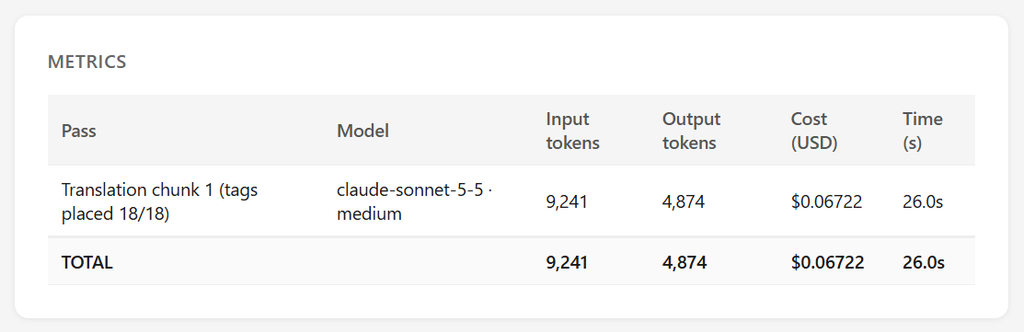
| Tags | The model rebuilds the text runs with code that it writes | The model places numbered markers; code validates them and inserts the tags, with a deterministic fallback and a safety net (18 of 18 placed at first attempt in Figure 1) |
| URLs | The model writes and applies a replacement pattern | Fixed rules in code after translation, with no model call |
| Writing the file | The model repacks a new .docx | Code writes the translations into the original file |
| Checks | The model runs a checklist in its reply | Code requests missing segments again and flags translations much longer than their source |
| Cost visibility | An account usage page, by day, in cents | A metrics table for every run: tokens, cost and time (Figure 1) |
The experiment
Six sample files were used to run a test, ranging from 781 to 1,402 words, 6,310 words in total.
- In the chat approach, a bilingual .docx file was uploaded with the extensive prompt. The chat read the glossary and the style guide from a shared drive, unpacked the file, translated it, wrote the translations back with code that it wrote itself and repacked the file.
- In the pipeline, a web app built with Google Apps Script reads the .mqxliff file, and the model is called only to translate. Code does everything else.
Two chat setups were measured: a fresh chat for each file, and an accumulated chat that already held earlier files and feedback.
- In the chat approach, cost was read from the account usage page, in cents, before and after each run, and time was measured from the start of the run to a usable file, without human review.
- In the pipeline, cost comes from the token counts that the API returns, and time was measured in the same way, without upload and download.
The pipeline and the accumulated chat were treated as producing publishable output, meaning a final light review in memoQ, the team’s CAT tool. A first run in a fresh chat would never produce publishable output, which is why the team moved to long chats that they could train through successive feedback.
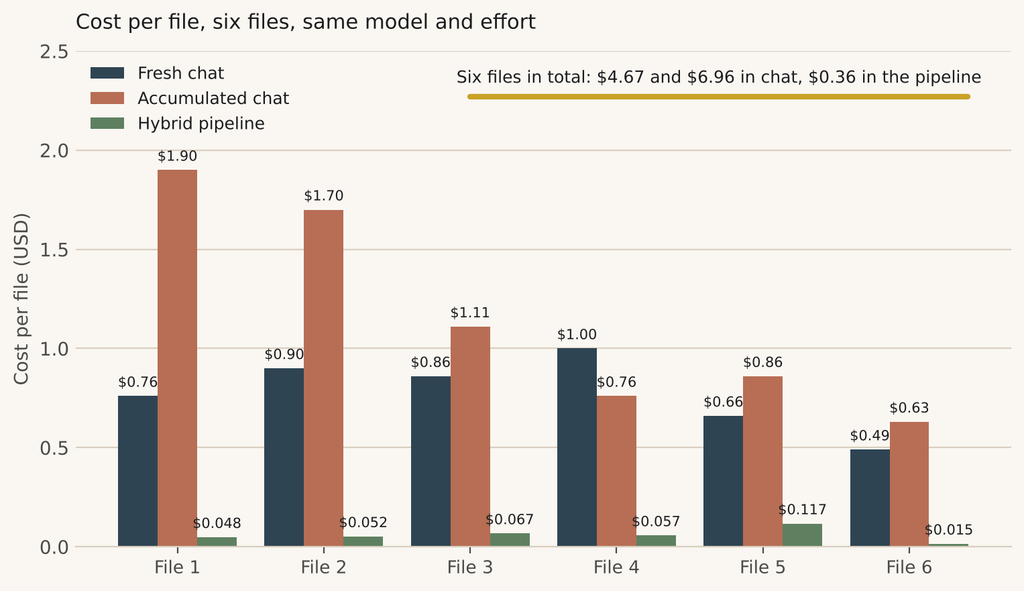
Key finding: The hybrid pipeline cost 92% to 95% less than the chat approach
Across the six files, the total cost of each approach proved to be very different:
- The fresh chats cost $4.67
- The accumulated chat cost $6.96
- The hybrid pipeline cost $0.36
The pipeline was cheaper on every file, by between 6 and 42 times, and it finished each file in 6 to 43 seconds.
| File | Words | Fresh chat (cost, time) | Accumulated chat (cost, time) | Pipeline (cost, time) |
|---|---|---|---|---|
| 1 | 1,020 | $0.76 · 3:37 | $1.90 · 4:50 | $0.048 · 19.5 s |
| 2 | 1,051 | $0.90 · 3:45 | $1.70 · 3:25 | $0.052 · 22.1 s |
| 3 | 1,153 | $0.86 · 4:05 | $1.11 · 3:51 | $0.067 · 26.0 s |
| 4 | 903 | $1.00 · 4:49 | $0.76 · 2:52 | $0.057 · 21.4 s |
| 5 | 1,402 | $0.66 · 2:56 | $0.86 · 3:03 | $0.117 · 42.9 s |
| 6 | 781 | $0.49 · 1:50 | $0.63 · 1:44 | $0.015 · 6.0 s |
| Total | 6,310 | $4.67 · 21:02 | $6.96 · 19:45 | $0.355 · 2:18 |
| Per 1,000 words | $0.74 | $1.10 | $0.056 |
The totals give three comparisons between the approaches:
- Pipeline against fresh chats: 92% cheaper and about 9 times faster.
- Pipeline against the accumulated chat: 95% cheaper and about 9 times faster.
- Accumulated chat against fresh chats: about 1.5 times the cost in total, and a similar time. Per file, the ratio varied between 0.8 and 2.5, so the two setups are better read as a range than as a fixed multiple.
What the team could see and decide
The table puts the three options side by side, using the same six files. Cost per 1,000 words is shown as the range across the files, and the output column states what was assumed about quality.
| Option | Six files: cost and time | Cost per 1,000 words (range) | Output | Fits best |
|---|---|---|---|---|
| Fresh chat for each file | $4.67 · 21:02 | $0.47 to $1.11 | Not usable at first run, per the team | One off tasks with no consistency need |
| Accumulated chat | $6.96 · 19:45 | $0.61 to $1.86 | Treated as publishable | Open ended work that needs judgement and feedback |
| Hybrid pipeline | $0.36 · 2:18 | $0.02 to $0.08 | Treated as publishable | Repeatable work in volume, with rules written down once |
These numbers let the team see what each file costs and decide which tool fits which job. A chat remains the better tool for open ended work. A pipeline fits work that repeats, because the glossary, the rules and the file handling are set up once and then cost almost nothing to run. The first step was visibility: a cost per file, which nobody had before. My work ended at the numbers.
If you would like to know more and take a look at the anonymised pipeline code and the original prompt, get in touch.

TOKEN RECEIPT: Both the experiment and the case study were drafted with Claude Sonnet 5.5, and the code of the hybrid pipeline was generated with Claude Code. The drafts then went through several rounds of human review, as well as through a quick sanity check with GPT-6. The chat that guided the work probably cost more than all the test runs together.
Estimated tokens consumed – Chats (experiment and case study): ~21,000,000 | Estimated cost: ~£48
Estimated tokens consumed – Claude Code (pipeline code): ~8,000,000 | Estimated cost: ~£6
Estimated tokens consumed – GPT-6 (cross-check): ~40,000 | Estimated cost: ~£0.30
The experiment showed that the cheapest token is the one that is never sent. Most of the savings came from steps that never needed AI at all.